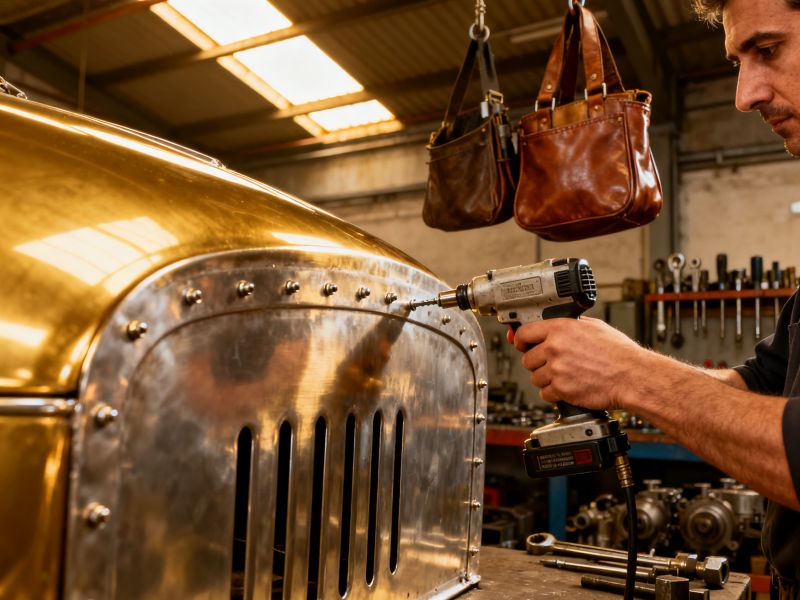
Carroso doesn't chase trends. Walk into the workshop in Modena and you'll see the same oak workbenches the founder salvaged from a shuttered carriage house in 1954. The smell of cured leather and machine oil hasn't changed. What has changed is the waiting list. Three years, minimum, for a standard coupé. Five for anything with a bespoke chassis.The name itself carries weight. Carroso is a family surname, not an acronym or a marketing invention. Enzo Carroso built his first competition engine from a wrecked aircraft motor and a hand-drawn crankshaft. That engine seized after eleven minutes on the track. He kept the broken rod on his desk for forty years. His granddaughter runs the company now, and that rod still sits in a glass case near the reception desk. You can't fake that kind of continuity. Carroso as a brand feels less like a manufacturer and more like a lineage — one that happens to produce about 180 cars annually.I spent an afternoon in their chassis bay last spring. A technician named Marco was hand-riveting an aluminum firewall. No power tools. He told me the rivet pattern follows a template from 1962, and that a CNC machine would do it in ninety seconds. "But then it wouldn't be Carroso," he said, shrugging. That's the tension at the heart of the company. They use computational fluid dynamics for cooling ducts。yes, but the final bending of the brake lines is still done by feel. Not because they're luddites. Because the feel matters. Carroso's engineering philosophy treats digital tools as silent partners, never as replacements for the hand that turns the wrench.The cars themselves reflect this duality. The current GT model produces 610 horsepower from a twin-turbo V8, yet the throttle pedal has a longer travel than most modern sports cars. Deliberate. It forces you to drive with intention rather than reflex. The interior smells of vegetable-tanned leather and beeswax — no synthetic sealants. I asked the lead designer why they don't offer a dual-clutch gearbox. His answer: "Our customers shift gears because they want to, not because they have to." That sounds nostalgic, but it's actually a business decision. Carroso's average buyer owns four other cars;they come here for the thing the others lack. Call it mechanical honesty.
Is Carroso relevant in an era of electric crossovers and subscription features?Probably not for everyone. The waiting list suggests they don't need to be. What strikes me most is how little the company seems to care about scaling. They rejected a buyout offer from a German conglomerate in 2019. The CEO's comment at the time: "We'd rather make fewer cars than more compromises." That's either admirable stubbornness or commercial suicide. Given the order book, I'd lean toward the former. Carroso won't electrify until solid-state batteries can handle repeated track sessions without thermal throttling — a stance that might age poorly. But it might also age exactly right. For now, the rivets go in by hand, one at a time.